
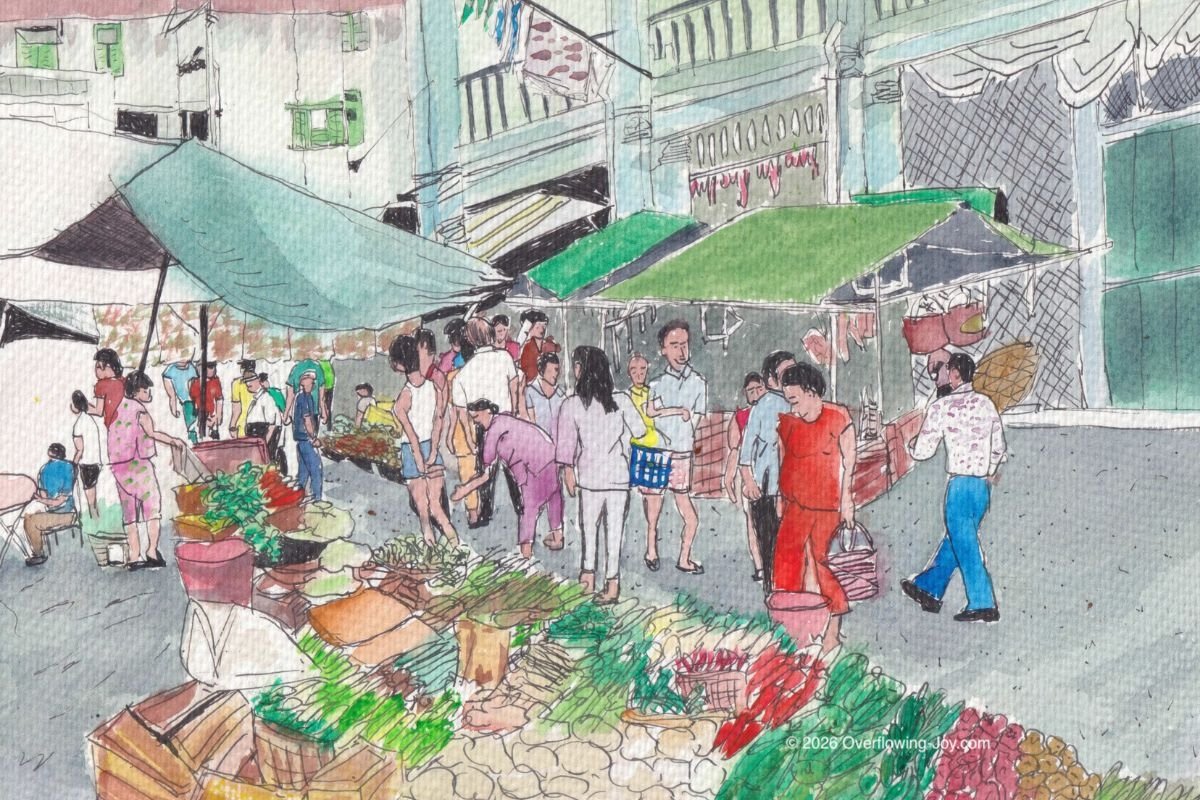
A Wet Market
A simple roadside stall, with fruits, vegetables, and all kinds of farm-grown produce displayed on the floor along a morning alley, was once a familiar sight in the neighbourhoods. The market was always alive with activity, the cheerful greetings of stallholders, the lively conversations of customers, and the colourful display of fresh produce in all shapes and sizes, carefully arranged to attract the early morning shoppers. Families came with their baskets and shopping bags, choosing what they needed to prepare the day’s meals.
As I reminisced about such scenes, I was reminded that a visit to the wet market was about much more than simply buying groceries. It was also a place where friendships were nurtured and community was experienced in the most ordinary ways. Familiar faces exchanged warm smiles and friendly conversations. Stallholders knew their regular customers, and customers knew the people who served them. A simple greeting, a few words of conversation, or a familiar smile could brighten someone’s morning and make the market feel like more than just a place of business.
At the fish stall, customers carefully selected their fish before handing their choice to the fishmonger, who skilfully cleaned, prepared, and packed it with care. As we watched, we could almost imagine the delicious home-cooked meal already taking shape in the minds of those preparing to return home, a nourishing dish lovingly prepared and eventually shared around the family table. These simple, familiar routines, repeated week after week, were quiet expressions of care, friendship, and community.
Looking back, such ordinary moments also remind us of God’s faithful and abundant provision. Behind every basket of vegetables, every piece of fruit, and every freshly caught fish are countless hands through which God provides for our daily needs, the fishermen who brave the seas, farmers who cultivate the land, workers who harvest the crops, vendors who rise before dawn, and market stallholders and fishmongers who faithfully serve their customers. What may seem like an ordinary morning market is, in many ways, a beautiful picture of God’s provision working through the hands of people.
God provides for our physical needs, but His care does not stop there. He knows that we need more than food for our bodies. We need love, friendship, encouragement, purpose, strength, and a sense of belonging. Through our families, friends, neighbours, and communities, He often meets these needs in ways that we may not immediately recognise. A friendly conversation, a helping hand, a listening ear, or simply the presence of someone who cares can become a quiet expression of God’s love.
More importantly, God cares for our spiritual needs. Through His Word, He gives us wisdom and guidance. Through His presence, He gives us comfort and peace. Through His grace, He gives us strength when we are weary, hope when we are discouraged, and courage when the road ahead seems uncertain. He watches over us with loving and faithful eyes, knowing our needs even before we bring them to Him. As Jesus reminds us, our Heavenly Father knows what we need, and we can trust Him to care for us.
When we look carefully at the familiar scenes of everyday life, we begin to see God’s fingerprints everywhere. His provision may come through the food on our tables, the roof over our heads, the hands that serve us, the friends who stand beside us, or the quiet moments when He reminds us that we are never forgotten. His watchful eyes are upon us not only in the extraordinary moments of life but also in the ordinary routines of each day.
May we never take these blessings for granted. Every good and perfect gift ultimately comes from our Heavenly Father. May we learn to pause, notice, and give thanks for the abundance of His provision for our daily bread, our families and friends, our health and strength, our work and purpose, and most of all, His unfailing love and grace.
And as we receive so freely from His generous hands, may we also become channels of His goodness. May we share what we have with those in need, encourage those who are weary, welcome those who feel alone, and offer friendship to those who may simply need someone to talk to. In our own small ways, we can become part of God’s loving provision, allowing His blessings to flow through our hands and into the lives of others.
The market may have been an ordinary place, and the routines may have seemed unremarkable. Yet within those simple scenes were reminders of something profound: God sees us, God knows our needs, and God faithfully provides. His watchful eyes never leave us, His loving presence never forsakes us, and His grace is sufficient for each new day.
Bible Verse:
They shall be abundantly satisfied with the abundance of your house. You will make them drink of the river of your pleasures.
Psalm 36:8 WEB
Blessings:
God has faithfully provided for both our bodies and our souls. Through the work of many faithful hands, He has supplied our daily needs, and through His Word, His presence, and His grace, He has nourished our hearts, strengthened our faith, and drawn us closer to Him.
Reflection Point:
God’s provision is far greater than we often realise. Looking back, we can see that He has faithfully sustained us—not only with food for our tables, but also with the spiritual nourishment, strength, wisdom, and hope we have needed for every season of life.
Reflection Question:
As I reflect on God’s faithfulness, how has He provided for both my physical and spiritual needs? In what way can I share His provision and encouragement with someone who needs it today?
Action to Consider for this week:
Share God’s provision with someone this week. You could bless a neighbour or friend with a meal, buy groceries for someone in need, or invite someone to your table. At the same time, share a word of encouragement, a Bible verse, or pray with someone who may be spiritually weary. As God has nourished both your body and your soul, become a channel of His provision to others.
Hymn for the Reflection
Praise God From Whom All Blessings Flow
Hymn Writer
Thomas Ken (1637–1711) was an English bishop, preacher, and one of the finest hymn writers of the seventeenth century. He was known for his deep personal devotion, courage, humility, and unwavering commitment to biblical truth.
Educated at Oxford University, Ken became Bishop of Bath and Wells. Throughout his ministry, he earned a reputation for integrity and faithfulness, even refusing to compromise his convictions when it cost him his position.
Although he wrote many devotional works, Thomas Ken is remembered most for a single verse that has become one of the most frequently sung hymns in Christian worship: “Praise God, from whom all blessings flow…”
For more than three centuries, Christians around the world have concluded worship services with these simple yet profound words of praise.
The Story Behind the Hymn
The famous Doxology was originally not written as a separate hymn.
In 1674, Thomas Ken published a devotional manual titled A Manual of Prayers for the Use of the Scholars of Winchester College. It included three hymns for students: A Morning Hymn, an Evening Hymn and a Midnight Hymn
At the conclusion of both the Morning and Evening Hymns, Ken added the same short verse of praise: “Praise God, from whom all blessings flow…”
His purpose was simple yet profound: to encourage believers to begin and end each day by giving thanks to God.
Over time, churches recognised the beauty and theological richness of these four lines. The concluding verse began to be sung independently and eventually became known simply as The Doxology.
Today it is sung in churches around the world after offerings, baptisms, communion services, weddings, and many other occasions as a joyful expression of gratitude to the Triune God.