
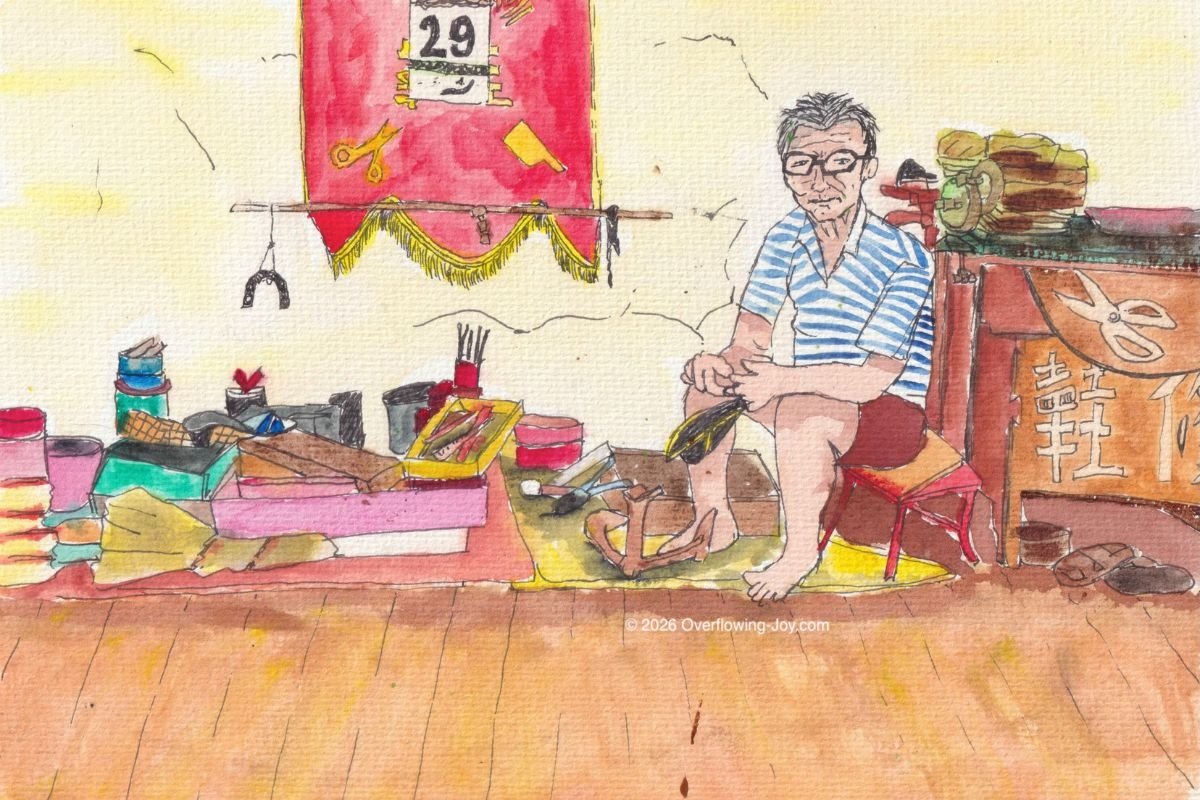
A Cobbler
I enjoy working with my hands, experimenting, creating, taking things apart, and sometimes destroying countless things along the way, more than I could ever remember! Somehow, this interest in making and creating has always been there, although I never really stopped to ask where it came from or why I enjoy it so much.
Then, one quiet day, I began to search through my memories, wondering if there was something in my childhood that might explain this fascination with creating things. As I thought about my school days, I remembered the art and craft lessons. I was never particularly good at art. In fact, I probably managed to scrape through with a passing grade largely through the kindness and grace of my art teacher!
But as I searched deeper into those memories, I remembered something else. I always enjoyed making prints on T-shirts using very simple and primitive methods, drawing, cutting shapes, and using markers to create my own designs. The results were certainly not beautiful, and by any artistic standard, they might even have looked rather ugly! Yet I remember the joy I felt when I saw something I had made with my own hands. It gave me a little sense of achievement and, more importantly, it gave me joy.
Perhaps that was the earliest glimpse of the creative interest that I still enjoy today. I may not have been particularly talented, but I enjoyed the process of experimenting, making mistakes, trying again, and seeing something slowly take shape.
As I reflected on this, I began to see another dimension. Perhaps God has been gently moulding me throughout my life in ways I did not recognise at the time. He plants interests, abilities, curiosity, and a desire to create within us. Sometimes these things appear insignificant when we are young, only to become meaningful much later in life.
God is our Maker and Moulding Hand. Yet He does not mould us like a piece of clay that has no choice of its own. He gives us room to explore, to choose, to try, to make mistakes, and even to take a different path. He invites us to discover what He has placed within us rather than forcing us into a shape that we think we ought to become.
How often do we do the opposite? We try to mould ourselves according to our own plans. We compare ourselves with others and think we should be more talented, more successful, or more capable. We try to make life fit the shape we have imagined for ourselves. And when things do not turn out as planned, we become frustrated or disappointed.
Perhaps the better way is to place ourselves in God’s hands and allow Him to mould us, while remaining open to where He leads. This does not mean that we simply sit back and do nothing. We still explore, learn, create, work, make choices, and take responsibility for our lives. But we do so with an openness to God’s direction, trusting that He knows us better than we know ourselves.
Just as the potter works with a piece of clay, sometimes adding, sometimes removing, sometimes reshaping, God patiently works in our lives. There may be seasons when He allows us to remain as we are, and other seasons when He gently reshapes our priorities, attitudes, and desires. What may look like an unexpected detour to us may become part of His larger work in us.
I am thankful that God simply allowed me to discover the joy of making things with my hands. What began with crude drawings, cut-out shapes, and imperfect T-shirts has, many years later, become a source of relaxation, creativity, and quiet joy.
Perhaps that is one of the beautiful things about God’s work in our lives. He does not always reveal the whole picture at the beginning. He gives us opportunities to explore and discover, and along the way He gently shapes us into the person He created us to be.
We are not all called to be artists, craftsmen, musicians, teachers, or leaders. We are each uniquely made, with different interests, abilities, experiences, and opportunities. There is no single mould that we must all fit into.
The question is not simply, “What can I become?” but also, “What is God gently shaping me to become?”
Perhaps we can stop trying so hard to make ourselves into what we think we should be and instead place our lives in the hands of the One who knows us completely. When we allow Him to lead, we may discover gifts and possibilities within us that we never knew were there.
And sometimes, like an imperfect piece of art, we may look at our lives and see only the mistakes, rough edges, and things that did not turn out the way we expected. But God sees something more. He sees what we can become in His hands.
“We are the clay, and You our potter; and we all are the work of Your hand.” — Isaiah 64:8 (WEB)
Perhaps the greatest joy is not in creating a perfect work of art, but in knowing that we ourselves are still a work in progress and that we are safely in the hands of the Master.
Bible Verse:
Yahweh will guide you continually, satisfy your soul in dry places, and make your bones strong. You will be like a watered garden, and like a spring of water, whose waters don’t fail.
Isaiah 58:11 WEB
Blessings:
Looking back, we can see that God’s greatest blessing has never been merely the destination, but His faithful presence throughout the journey. Every step He guided, every burden He carried, every prayer He answered, and every moment He stayed beside us is a testimony of His unfailing love.
Reflection Point:
God’s greatest blessing is His constant presence. As we look back, we discover that He has been faithfully walking with us, guiding, strengthening, and caring for us every step of the way.
Reflection Question:
When I reflect on my life’s journey, where have I seen God’s hand guiding and sustaining me? How can I become more aware of His presence as I walk through today?
Action to Consider for this week:
This week, place yourself in God’s hands. Ask Him to mould your heart, guide your steps, and help you discover the gifts He has placed within you.
Hymn for the Reflection
Saviour, Like a Shepherd Lead Us
Hymn Writer
Dorothy Ann Thrupp (1779–1847) was an English hymn writer and children’s author who had a remarkable ability to express profound biblical truths in simple, memorable language.
Although she never married and lived a relatively quiet life, she devoted much of her ministry to the spiritual nurture of children and families. Her hymns often emphasised God’s love, guidance, and protection, making them suitable for both young believers and adults.
While historians have debated whether she wrote every hymn traditionally attributed to her, Saviour, Like a Shepherd Lead Us has long been associated with her name and remains one of the most treasured hymns on the theme of Christ as the Good Shepherd.
The Story Behind the Hymn
Unlike many hymns that can be traced to a specific life event, Saviour, Like a Shepherd Lead Us appears to have been written as a devotional meditation on the biblical image of Jesus as the Good Shepherd.
During the early nineteenth century, many hymn writers sought to produce songs that would help families and children understand the Christian faith through familiar biblical pictures. Few images were more comforting than that of a shepherd caring for his sheep.
The hymn invites believers to see themselves as sheep who depend completely upon the Shepherd’s guidance, protection, and provision. Rather than celebrating human strength, it acknowledges our need for Christ to lead us safely through every stage of life’s journey.
Its gentle melody and reassuring words have made it a favourite in churches for nearly two centuries, especially at baptisms, family services, and times of personal devotion.