
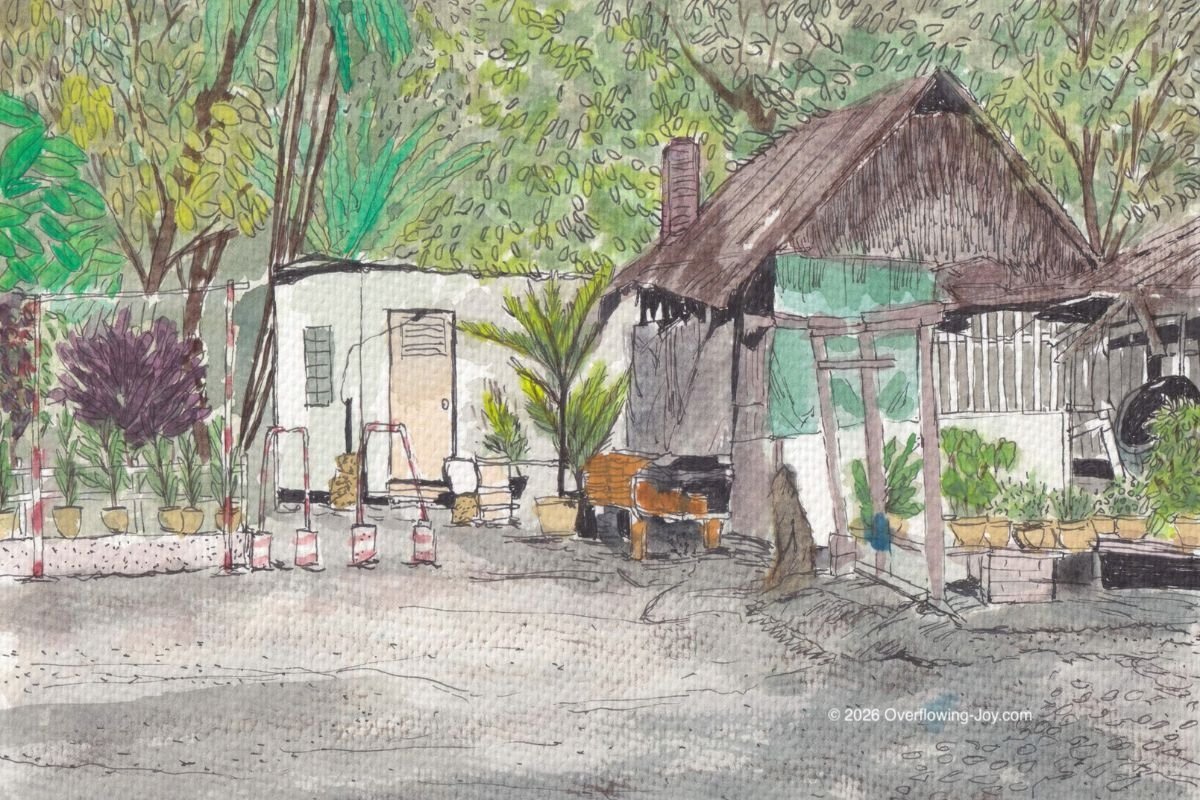
Attap House
It is very rare to see an attap house in our nation today. Yet, not so long ago, attap houses were a familiar sight and a common dwelling for many Singaporeans. They may have seemed simple and fragile compared with the concrete homes we live in today, but they provided something essential, a roof over the head, a place of rest, and shelter from the rain and sun.
Today, most of us live in concrete flats and houses designed to withstand Singapore’s tropical weather. Beyond our homes, our city has also been thoughtfully designed with covered walkways, sheltered bus stops, MRT stations, void decks, and public spaces that provide protection just when we need it. When the rain suddenly falls or the sun becomes unbearably hot, we instinctively look for somewhere to take shelter. These simple conveniences are easily overlooked because they have become such a normal part of our daily lives. Yet they are blessings that quietly make our lives safer, easier, and more comfortable.
A shelter, whether a simple attap roof or a modern concrete structure, is more than something over our heads. It is a quiet reminder of God’s provision through human hands. Behind the buildings, designs, materials, and people who build and maintain them is a God who cares about the needs of His creation. These shelters carry out a silent ministry every day, offering comfort and protection to countless people without asking anything in return.
In much the same way, God has been our shelter throughout our journey of life. He has watched over us in ways we may never have realised, protecting us from dangers we never saw, guiding us through uncertainty, providing when we did not know where our help would come from, and carrying us through seasons when our own strength was not enough. Like a roof that shields us from a sudden downpour, His presence has covered us when life’s storms threatened to overwhelm us. Like a sheltered walkway that allows us to continue our journey despite the rain, His grace enables us to keep moving forward even when circumstances are difficult.
Sometimes we only recognise God’s protection when we look back. There may have been occasions when something did not happen as we expected, a door that remained closed, a journey that was delayed, or a plan that did not work out. At the time, we may have wondered why. Only later may we realise that God was quietly protecting, redirecting, or preparing us for something else. Some of His greatest acts of care may be the quietest ones, like the moments when His loving hand held us even though we were completely unaware of it.
God’s shelter does not mean that we will never experience storms. Rather, it assures us that we do not have to face those storms alone. There will be days when we feel tired, discouraged, anxious, or uncertain about what lies ahead. Yet we can pause beneath the shelter of His love, regain our strength, and continue the journey. The God who has sheltered us in the past remains our refuge today and will be with us in whatever tomorrow brings.
But God’s shelter is not meant to end with us. Having experienced His care, we are also called to become a place of refuge for others. We may not be able to solve another person’s problems or remove every storm from their lives, but we can offer a listening ear, a word of encouragement, a helping hand, a warm meal, a place to rest, or simply our presence when someone feels alone.
There are people around us who may be carrying burdens that we cannot see. A neighbour may be struggling quietly. A friend may be anxious about the future. An elderly person may feel lonely. Someone who appears strong may simply need someone to walk alongside them for a while. We may never know how much a small act of kindness can mean to someone who is going through a difficult season.
Just as a shelter does not ask who deserves protection before providing shade from the rain, may we also learn to extend God’s love generously. Let us become a shade to the weary, comfort to the hurting, encouragement to the discouraged, hope to the anxious, and kindness to those carrying heavy burdens. When we offer someone a little of the shelter we have received from God, His love becomes visible through our lives.
May we therefore rest confidently under the shelter of God’s unfailing love. And having found refuge in Him, may we be willing to open our hearts and extend that same refuge to others. In a world where many are searching for security, acceptance, and hope, may our lives become quiet shelters where people can experience a glimpse of God’s gracious love, peace, and care.
“He who dwells in the secret place of the Most High will rest in the shadow of the Almighty.” — Psalm 91:1 (WEB)
May we never take God’s shelter for granted. May His love cover us, His presence guide us, and His grace enable us to become a shelter of kindness and hope for someone else today.
Bible Verse:
He who dwells in the secret place of the Most High
will rest in the shadow of the Almighty.
Psalm 91:1 WEB
Blessings:
We can see that God has blessed us with His faithful protection. He has watched over us in ways we often never noticed, guided our steps when the path was uncertain, sheltered us in difficult seasons, and surrounded us with His loving presence every day.
Reflection Point:
God’s protection is often quiet and unseen. As we look back, we discover that His faithful presence has sheltered, guided, and sustained us far more than we ever realised.
Reflection Question:
When I reflect on my life, where can I see God’s protecting hand and faithful care? How can I become a source of shelter, encouragement, or support for someone who may be feeling vulnerable today?
Action to Consider for this week:
Look for someone who may be carrying a burden or facing uncertainty. Offer a listening ear, a word of encouragement, practical help, or a prayer. Let your kindness become a small reflection of the shelter and care God has faithfully given you.
Hymn for the Reflection
A Mighty Fortress Is Our God
Hymn Writer
Martin Luther (1483–1546) was a German theologian, pastor, hymn writer, and the leading figure of the Protestant Reformation. Originally trained as a lawyer, Luther entered an Augustinian monastery after a life-changing experience during a violent thunderstorm, where he vowed to dedicate his life to God if he survived.
As he studied the Scriptures, Luther became convinced that salvation is received by God’s grace through faith in Jesus Christ, not by human effort. In 1517, he published his famous Ninety-five Theses, challenging certain practices within the medieval church. This event marked the beginning of the Protestant Reformation.
Luther believed that every Christian should be able to understand and sing biblical truths. He translated the Bible into German and wrote numerous hymns so ordinary people could worship in their own language. Among all his hymns, “A Mighty Fortress Is Our God” is his greatest and most enduring work.
The Story Behind the Hymn
Martin Luther wrote “A Mighty Fortress Is Our God” during one of the most turbulent periods of his life and ministry.
The Reformation had brought fierce opposition from both political and religious authorities. Luther faced threats of arrest, condemnation, and even death. Europe was also experiencing widespread unrest, disease, and conflict, creating uncertainty for many believers.
Rather than placing his confidence in earthly power or personal strength, Luther turned to the promises of Scripture, especially Psalm 46.
Inspired by the psalm’s declaration that “God is our refuge and strength,” Luther composed this hymn as a bold confession of faith. It proclaims that although evil exists and trials surround God’s people, the Lord remains their unshakable fortress.
The hymn quickly became known as the “Battle Hymn of the Reformation.” It encouraged Christians to stand firm in their faith, trusting not in themselves but in God’s sovereign power and protection.
Nearly five centuries later, its message remains as relevant as ever. Believers continue to sing it during times of uncertainty, persecution, and challenge, finding confidence in the God who is our eternal refuge.