
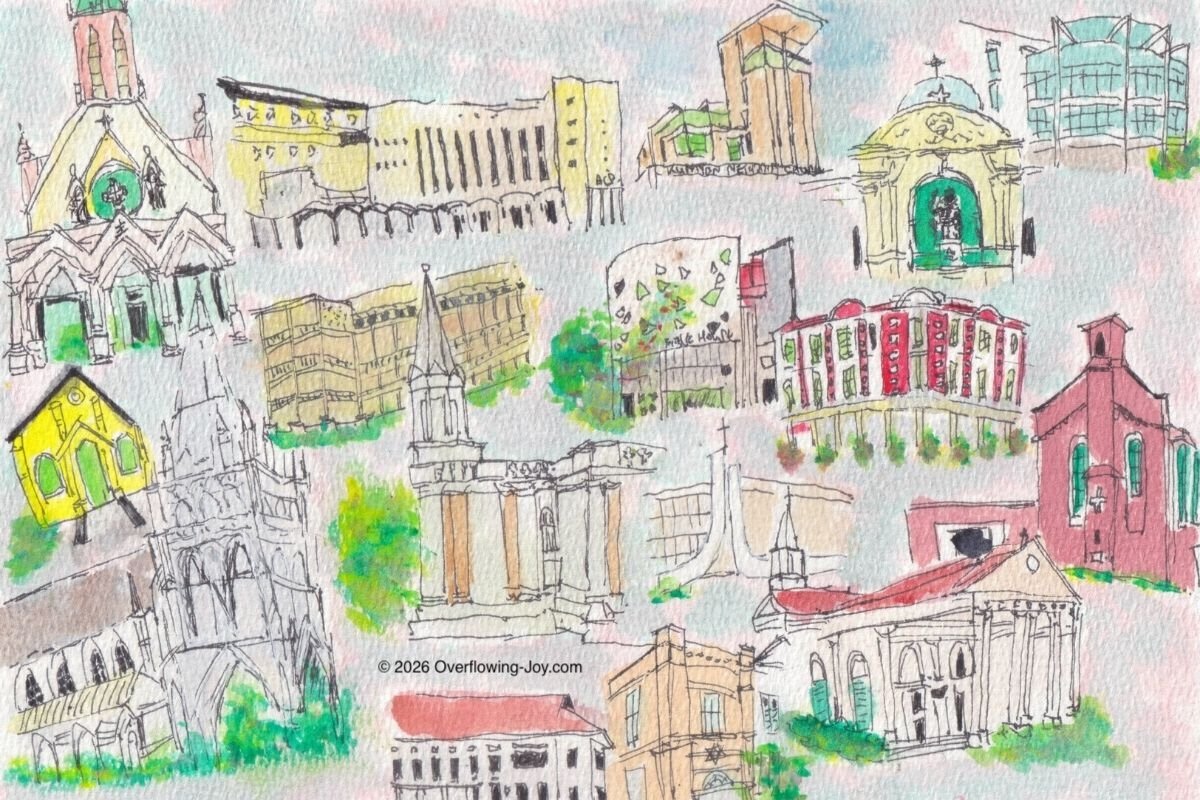
Heritage Walk
There is something special about walking through the historical lanes of Singapore and discovering the stories of those who came before us. Each old building, church, school, and street seems to carry a story of people who arrived in Singapore many years ago, often leaving behind their families, familiar surroundings, and comfortable lives to venture into a distant land. They came with little certainty about what awaited them, yet many gave generously of their time, abilities, resources, and even their lives to serve others and make a difference in the communities around them.
Their stories never fail to inspire me. They remind me that a meaningful life is not necessarily measured by how much we possess or how comfortable our lives become, but by what we are willing to give, how faithfully we serve, and whether our lives become a blessing to others. Many of these early pioneers could never have imagined how their sacrifices would continue to influence generations long after they were gone.
I have taken part in at least four of these historical walks, yet somehow, I never seem to tire of going through them again. Each time, there is something new to discover. Some stories are familiar, some details return from the corners of my memory, while other pieces help fill in the gaps of what I had previously forgotten. Although I may have heard the same stories before, hearing them again in the very places where history unfolded gives them a new meaning.
The walk itself is quite a journey. It takes us across a wide area, beginning at St Andrew Cathedral, passing the Armenian Church, the former ACS School, Bible House, MPH Building, Cathedral of the Good Shepherd, former SJI School, Kum Yan Methodist Church, Church of Saints Peter & Paul, former Catholic High School, Maghain Aboth Synagogue, the Christian Institute of Singapore, Prinsep Street Presbyterian Church, St Margaret’s School, the former Trinity Theological College, and the former Methodist Girls’ School, before finally ending by walking down to Cathay Building by the 127-step staircase famously known as the “100 Steps to Heaven.”
The entire walk takes approximately two and a half to three and a half hours. It can certainly be tiring, especially when the legs begin to remind us of our age! Yet the tiredness seems insignificant when compared with the enjoyment of walking alongside friends, family members, or even people we have just met. Conversations along the way, shared laughter, familiar stories, and new discoveries turn the walk into more than just a physical activity. It becomes an experience of fellowship, learning, reflection, and inspiration.
What touches me most is the faith and courage of those who came before us. They did not have the conveniences we enjoy today. They faced unfamiliar surroundings, limited resources, hardships, uncertainty, and sometimes great personal sacrifice. Yet they persevered. They planted seeds whose fruit they might never live to see. Their lives remind us that we do not always have to see the result of our efforts for our lives to have meaning.
This causes me to reflect on my own journey. At our stage of life, we may sometimes wonder what more we can contribute. Perhaps our working years are behind us, our energy is not what it once was, and we may feel that our most productive years have already passed. But the stories of those who came before us remind us that every season of life can still be useful in God’s hands.
We may not build a school, establish an institution, or travel to a distant land to serve others. Yet we can encourage a younger person, share a word of wisdom, pray for someone who is struggling, tell our children and grandchildren about God’s faithfulness, welcome someone who feels lonely, or simply make ourselves available when someone needs a listening ear. These may appear to be small things, but we never know how God may use them to influence another person’s life.
Perhaps this is one of the greatest lessons these historical walks have taught me: we are walking not only through history; we are also walking through our own God-given season of life. The people before us left footprints for us to follow. Now it is our turn to leave footprints that the next generation can follow.
As I walk along these old pathways, I am reminded that life itself is a journey. We may not know how far the road ahead will take us, but we can choose how we walk it. We can walk with gratitude for what we have received, humility for what we have learned, and generosity in what we give. Most importantly, we can walk with God, trusting Him to use whatever years, experiences, abilities, and opportunities remain in our hands.
The stories of the past should not merely make us nostalgic. They should inspire us to live more purposefully today. The sacrifices of those who came before us challenge us to ask: What legacy will we leave behind? Whose life will be better because we were here? What seeds of faith, kindness, wisdom, and love can we still plant?
Perhaps one day, long after our own journey has ended, someone may remember a simple word we spoke, a prayer we prayed, a kindness we showed, or the encouragement we gave at just the right moment. We may never know the full impact of our lives, but we can trust that God sees every faithful act.
So, although the walk may be tiring, I am grateful for every step. The aching legs eventually recover, but the stories, lessons, and inspiration remain in the heart. Each journey through these historical places reminds me to appreciate those who came before, to give thanks for what they have left behind, and to make the remaining journey of my own life count.
May God help us to live not merely as people who remember the past, but as people who carry forward its best lessons of grace, faith, courage, sacrifice, service, and love. May our lives, like the lives of those who walked before us, become a blessing to others and a testimony of God’s grace for generations yet to come.
Bible Verse:
Yes, even when I am old and gray-haired, God, don’t forsake me, until I have declared your strength to the next generation, your might to everyone who is to come.
Psalm 71:18 WEB
Blessings:
God has given us the gift of learning from those who walked before us, and the opportunity to use our own experiences, faith, and wisdom to encourage and bless the generations that follow.
Reflection Point:
Our lives are part of a continuing story of faith; just as we have been blessed by those who came before us, we are called to leave behind a legacy of faith, love, wisdom, and service for those who come after us.
Reflection Question:
What kind of legacy do I want to leave behind—not in possessions, but in faith, character, love, and service?
Action to Consider for this week:
Share one story of God’s faithfulness from your life with someone from the next generation, and encourage them with one lesson you have learned along your journey.
Take time to thank someone who has influenced your life, and consider how you can now become that same source of encouragement, wisdom, and faith to someone else.
Hymn for the Reflection
Nearer, My God, to Thee
Hymn Writer
Sarah Flower Adams (1805–1848) was an English poet, actress, and hymn writer. Born into a cultured family in Essex, England, she developed a love for literature, drama, and poetry from an early age.
Although she enjoyed success as a stage actress, poor health forced her to leave the theatre. She then devoted her talents to writing poetry, religious works, and hymns. Sarah worshipped in a Unitarian congregation, where she became known for her thoughtful and deeply devotional writings.
She wrote relatively few hymns, yet “Nearer, My God, to Thee” became one of the most beloved hymns in the Christian world, touching countless lives across many denominations.
The Story Behind the Hymn
Sarah Flower Adams wrote “Nearer, My God, to Thee” in 1841 at the request of her pastor, who was preparing a sermon on the story of Jacob’s dream at Bethel in Genesis 28.
Rather than writing about comfort or success, Adams reflected on Jacob’s experience of fleeing from home, sleeping alone in the wilderness with only a stone for his pillow. Despite his loneliness and uncertainty, Jacob encountered the presence of God in a profound way.
Adams recognised an important spiritual truth:
Sometimes our greatest trials become the very means by which we draw closer to God.
This became the central theme of her hymn.
Its opening words express this longing:
Nearer, my God, to Thee,
Nearer to Thee!
The hymn reminds believers that even hardship can become a pathway into deeper fellowship with God.